
Lagos, Nigeria – July 2025
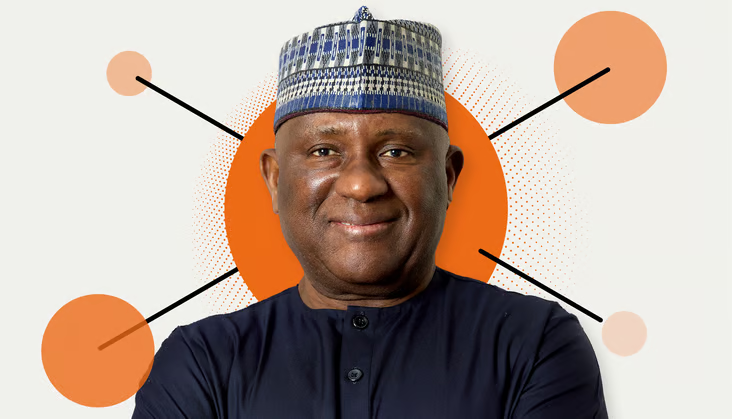
While the names Dangote and Otedola often dominate Nigeria’s corporate spotlight, Abdul Samad Rabiu has steadily risen as one of Africa’s most influential and low-profile billionaires. His company, BUA Group, is now a $5 billion industrial empire spanning cement, sugar, flour, real estate, and oil refining.
Born into wealth but determined to chart his own path, Rabiu launched BUA in 1988, initially importing rice and edible oil before expanding into steel and construction. Over the past two decades, his strategic focus on local manufacturing has transformed BUA into a cornerstone of Nigeria’s economy.
Today, BUA operates some of the largest cement plants in West Africa, competes directly with Dangote Group, and recently commissioned one of Nigeria’s most advanced sugar refineries. The company’s expansion into oil refining and ports infrastructure is also drawing global investor attention.
Despite his growing influence, Rabiu remains relatively media-shy, often preferring his business to speak for itself. “We believe in building, not boasting,” he said in a rare interview in 2024.
In 2020, Rabiu established the Abdul Samad Rabiu Africa Initiative (ASR Africa)—a $100 million social development fund targeting education, health, and social equity across Africa.
Analysts say his approach reflects a new generation of African industrialists who combine philanthropy with pan-African ambition. “Rabiu isn’t just creating factories—he’s creating ecosystems,” says business journalist Ngozi Akande.
In 2025, BUA Cement overtook several global competitors in market cap, and the company’s shares are among the best-performing on the Nigerian Exchange.
Rabiu has also played a quiet but crucial role in regional policy circles, supporting Nigeria’s push for AfCFTA (African Continental Free Trade Area) implementation and advocating for infrastructure-led growth across ECOWAS states.
With Africa’s population booming and demand for cement, food, and energy rising, BUA Group is poised for even more influence in the coming decade.
Whether in boardrooms or community projects, Abdul Samad Rabiu is increasingly seen not just as a billionaire, but as a builder of Africa’s future.