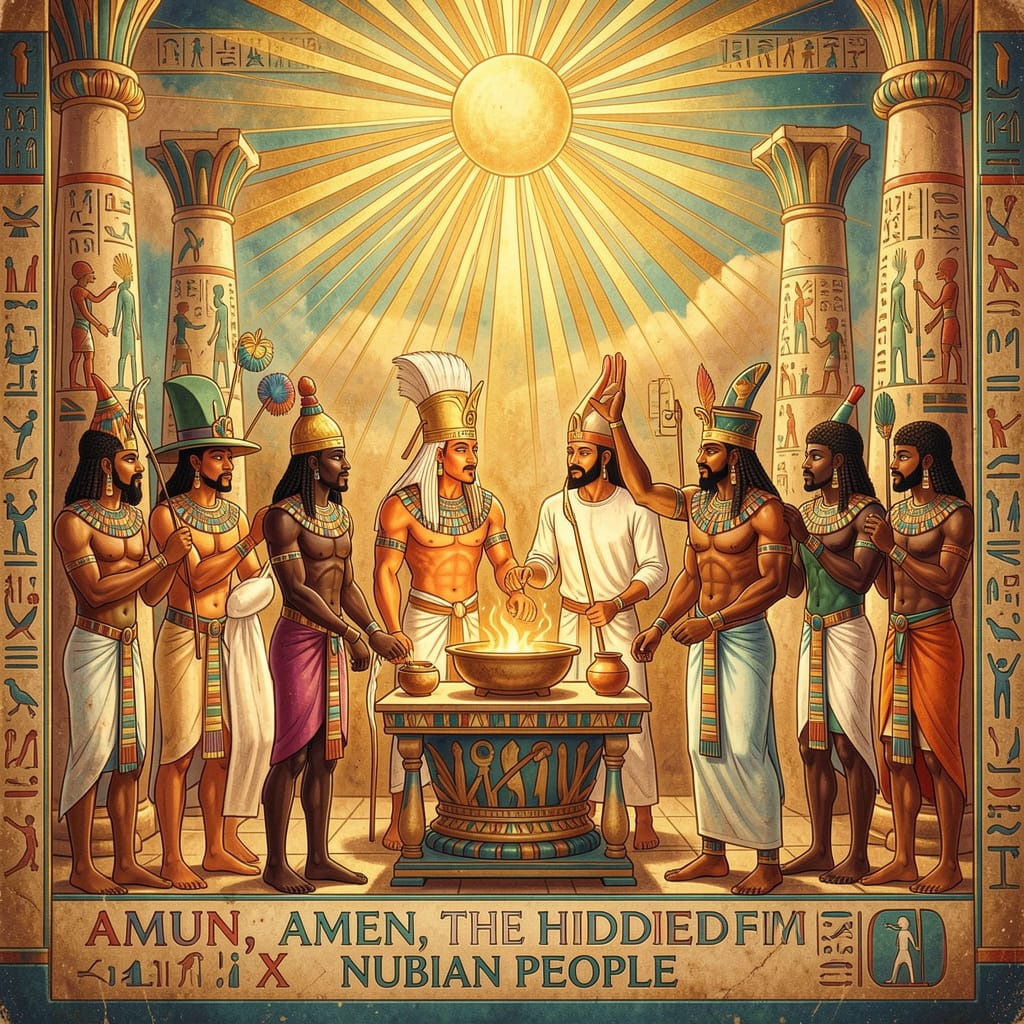

Amun, Amen, and the Hidden X:
An Ausarian Interpretation of the Unseen Principle in Spirit and Mathematics. Presented by the House of Ausar — Custodians of the Ausarian, Kushite-Kemetic Metaphysics
The Role of the House of Ausar
Across classical African civilization, knowledge was preserved through houses — priestly orders, intellectual lineages, and initiatory schools dedicated to maintaining and transmitting inherited metaphysical systems. The House of Ausar continues this tradition. It does not invent philosophy; it safeguards the Ausarian, Kushite-Kemetic metaphysics and interprets its principles for contemporary seekers.
This article reflects that custodial role. Here, the House of Ausar explores the relationship between Amun, Amen, and the mathematical X, showing how each expresses a single ancient principle: the truth that begins hidden before it becomes known.
1. Amun: The Hidden Foundation of Existence
In Ausarian metaphysics, Imn—widely known as Amun—embodies the principle of the hidden. His name means:
the unseen one
the invisible foundation
the unmanifest potential from which all things emerge
Amun is not absent; he is the underlying cause of existence. His hiddenness represents the truth that origins are raely visible, yet they shape everything. In classical Kemet:
Amun symbolized potential.
Ra symbolized manifestation.
Their union expressed the total cycle of reality.
This principle guided African temple science, moral philosophy, cosmology, and mathematics.
Amun is the source-beneath-the-surface — the beginning of all inquiry, spiritual or scientific.
2. Amen: Recognition of the Unseen Order
As Ausarian philosophy traveled through different African and Afro-Asiatic cultures, the sound and meaning of Amun transformed into the word Amen.
While today widely used in prayer, its ancient function remains intact:
Amen affirms trust in the hidden order behind appearances.
To say "Amen" is to acknowledge:
unseen truth
unseen structure
unseen causality
unseen alignment
This is not theological coincidence. It is the survival of an African metaphysical recognition:
The invisible is real, and the real does not depend on being visible.
Amen is the linguistic continuation of Amun's principle — a declaration that the unseen source remains the final authority.
3. Hidden Reality in Kushite-Kemetic Philosophy
Ausarian metaphysics teaches that reality unfolds through layers:
Amun — the unseeen source of potential
Ra — the visible expression of that potential
Ausar — the humen journey toward recognizing and aligning with the underlying order
Thus, the ancient African view of existence is not dualistic but layered. The visible world is not separate from the invisible; it is the surface of the invisible.
The initiate is trained to move through four modes of perception:
sensory perception
intellectual reasoning
intuitive insight
spiritual alignment
Each stage reveals more of what Amun concealed.
This philosophical structure directly mirrors the function of mathematical symbolism.
4. Why X in Mathematics Carries the Spirit of Amun
In mathematics, X represents:
the unknown
the unseen quantity
the missing value
the truth waiting to be uncovered
Its role parallels Amun's metaphysical function.
Solving for X is the intellectual equivalent of the Ausarian spiritual journey: moving from unawareness to recognition, from hiddenness to revelation.
Thus, X is more than a letter. It is the mathematical symbol of the unseen truth.
The House of Ausar recognizes X as a continuation—in symbolic form—of an African metaphysical idea that existed thousands of years before "European mathematics" adopted it.
5. How X Entered Mathematics: Historical Thread
During the North African and Andalusian mathematical renaissance:
Scholars wrote the unknown quantity as "shay" in Arabic, meaning a thing not yet known.
In Latin translations, the "sh" sound has no direct equivalent.
Translators replaced "sh" with x, which they considered close enough phonetically.
Thus:
shay' - xay - x
While the form changed, the meaning remained the same: X represents the hidden reality.
This historical process unintentionally preserved the African metaphysical pattern from a new direction — through language and symbol.